

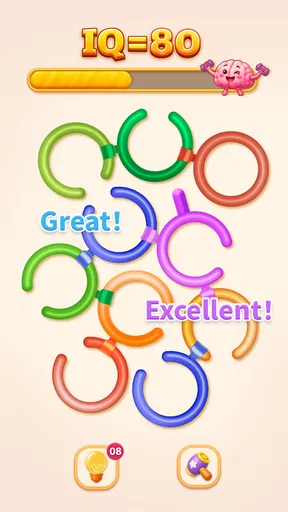
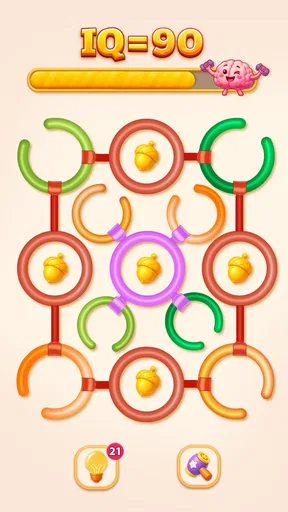
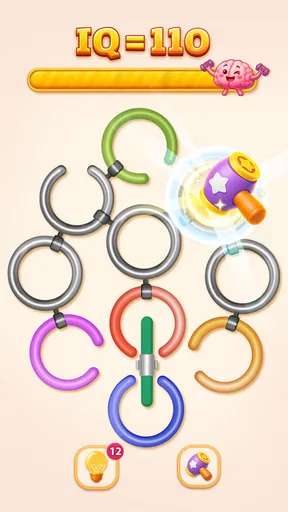
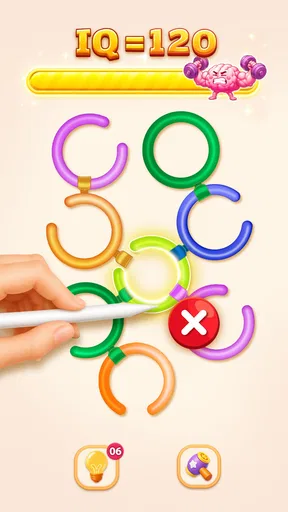
Rotate Rings review
 Analysis by GetAllApps
The appeal of Rotate Rings is easy to understand: it asks you to turn rings, read how their positions relate, and make a small logic problem feel calm rather than demanding. I find that a welcome change from puzzle games that turn every pause into a timer or a stream of distractions. This is a free puzzle game from Nebula Studio, and its simple central idea makes it easy to try for a few minutes without needing to prepare for a long session.
A quiet first impression, built around one clear idea
At its best, a ring-rotation puzzle gives your attention one useful job. You look at the arrangement, consider how a turn will affect the pieces around it, and decide whether to act now or inspect the pattern again. That loop suits short breaks: I can imagine opening the game while waiting for a kettle, between tasks, or during a quiet commute, then stopping when I have had enough mental activity.
The game’s identity is deliberately focused. It is not a sprawling adventure with a story to follow, nor a collection of unrelated activities competing for attention. The rings are the point. That clarity is a strength if you want a compact logic challenge, though it also means the experience depends heavily on whether you enjoy visual patterns and incremental problem-solving. Players looking for character-driven progression or a broad mix of puzzle types may find the concept too narrow.
Its published average is 4.8, based on around 262,000 ratings, and it has passed 10 million installs. Those figures suggest that the basic premise has found a large audience, but they do not tell me whether the style will suit any particular player. The more useful question is whether you enjoy taking a moment to reason through a spatial arrangement instead of tapping quickly and hoping for a lucky result.
How the visual language supports the puzzle
Rotating rings naturally make the board feel like a set of connected parts rather than a flat row of answers. That is a good fit for logic play: the eye can follow a circular relationship, and each turn invites you to think about how one change might influence the whole arrangement. In a puzzle built around rotation, the shape is not just decoration; it is part of how you understand the problem.
I would approach each board by first looking for relationships, not by immediately turning pieces at random. Pick out a recognizable pattern or a section that seems close to alignment, then consider which rotation could preserve what is already working. This is a practical way to make a ring puzzle feel less like trial and error. It also helps you notice when a move that improves one area might disrupt another, which is often the interesting part of this kind of logic challenge.
The game is best suited to players comfortable with visual reasoning. If you prefer word clues, arithmetic, or a clear sequence of written instructions, a conventional crossword or number puzzle may feel more natural. Here, the challenge is to read a changing arrangement and build a mental picture of the consequences of a turn. That can be satisfying, but it may take a little patience if spatial puzzles are not usually your thing.
One useful habit is to pause before repeating a move. When a ring seems nearly right, take a beat and compare the current layout with the result you are aiming for. A quick, deliberate check can prevent the common puzzle-game trap of making several impulsive changes and then losing track of what improved. This approach is especially helpful when playing in a noisy or interrupted setting, where it is easy to forget the pattern you were trying to create.
Sound, pacing, and the right kind of break
The game is presented as a relaxing experience, and that framing matters because the ring mechanic works best when you have room to think. I would not treat it as a reflex test. Its natural rhythm is closer to observing, making a considered adjustment, and checking the result. That makes it a plausible companion for a low-pressure break when you want your mind occupied without turning the moment into a competition.
Sound can strongly affect whether a puzzle feels restful or tiring, so I recommend judging it in the context where you plan to play. If you are settling down before bed or using the game in a shared space, keep the volume at a comfortable level and see whether the audio supports concentration for you. If you prefer silence, a puzzle based on visual relationships can still make sense as a quiet activity. I would not choose it specifically for a rich musical or narrative soundscape; the appeal is the measured puzzle rhythm, not a soundtrack-led experience.
The same pacing makes it easy to use in small windows of time. A realistic routine might be to play a few rounds while waiting for a bus, then put the phone away without needing to remember a complicated story or a long chain of objectives. That convenience has a trade-off: if you want a game that pulls you into a substantial world or offers a dramatic payoff for a long session, this restrained format may feel slight.
Because the game is described as playable offline, it can also suit moments when a connection is unavailable or when you would rather not rely on one. That is a practical advantage for travel and waiting rooms. I would still make sure the game is ready on the device before heading somewhere with poor reception, rather than assuming every store or account-related function will work offline. The puzzle itself is the reason to open it in those situations, not a promise that every surrounding service behaves the same way.
Where the mechanics fit—and where they may not
Compared with the usual alternatives in the puzzle category, Rotate Rings occupies a more spatial lane than a crossword, trivia game, or number grid. Those alternatives often give you clues or symbols to interpret; here, the central task is to reason about rotation and arrangement. If you like seeing a pattern change in response to your choices, that direct connection between action and visual result is appealing. If you want variety from one session to the next, a broader puzzle collection may offer better value for your attention.
A helpful way to play is to set a small intention before you begin: look for one relationship to improve, test a move, and then reassess instead of spinning rings repeatedly. This keeps the challenge legible and makes it easier to learn from a move that did not work. It is also a good approach when you are tired. A relaxed puzzle should leave room for thought, not demand that you memorize a complicated strategy while distracted.
There is a limit to what a single mechanic can offer. Rotation is a clean foundation, but players who quickly tire of repeated visual logic may want to alternate with a different kind of game. I would also skip it if your main priority is fast action, social competition, or a strong sense of progression. The game’s appeal is narrower and quieter: a contained problem, a few thoughtful decisions, and the satisfaction of seeing an arrangement make more sense.
The offline brain-training angle is best treated as a description of the activity, not a reason to expect a measurable change in concentration or memory. I would play because the puzzles are an enjoyable way to exercise attention in the moment. If you want a formal training program with tracked goals or detailed performance feedback, choose a tool designed around those needs instead.
Practical details before you install
The game is free to download, with optional in-app purchases priced from $0.99 to $9.99 per item. I would start with the free version and decide whether the core ring puzzles hold my interest before spending anything. That is a sensible approach for a focused game: try its central loop first, and only consider an optional purchase if it clearly adds something you personally want.
It is rated for Everyone, so its presentation is intended for a broad audience. The current version is 1.1.6, and the stated minimum operating-system requirement is 7.1. Before installing, I would check the device’s available space and compatibility through the relevant app store, especially if the device is older. The game was released on July 31, 2026, and the developer is Nebula Studio.
For a quick compatibility decision, the minimum OS figure is useful, but the actual store page on your device is still the place to check whether your particular model can install the current build. If you are choosing it for a child or a family device, the Everyone age rating is a helpful starting point; I would still review the purchase controls together if optional spending is a concern.
Who will enjoy its calm, focused mood
I would recommend Rotate Rings to someone who likes visual logic, wants a low-pressure game for short gaps in the day, and is happy to work with one central puzzle idea. Its circular format gives the thinking a distinct shape, and the offline suitability makes it practical when internet access is unreliable. The audience reach and strong average rating are encouraging signs, but personal taste matters more than popularity here: enjoying spatial puzzles is the key.
I would steer a friend toward a different option if they want a story, a broad range of puzzle formats, a fast score-chasing loop, or a game that constantly introduces new kinds of interaction. I would also hesitate to recommend it to someone who finds visual rotation confusing or frustrating. A word puzzle or a number-based logic game may be a better fit for those players because its clues and rules are often easier to keep in view.
My overall impression is that Rotate Rings works best when treated as a small, thoughtful pause rather than a game that must fill an evening. The circular logic gives it a clear identity, and its measured pace suits casual play, including offline moments. Its main limitation is also its defining choice: it concentrates on one kind of puzzle. If that focus sounds appealing, try it freely and see whether the act of turning, observing, and refining a pattern becomes a satisfying routine.
Pros and cons
Pros
- Simple controls make the puzzle easy to pick up.
- Short levels suit quick play sessions.
- Rotating rings offers a clear central mechanic.
- Visual layouts are easy to understand.
- The game can be played at your own pace.
Cons
- Later puzzles may feel repetitive.
- Some levels can be difficult without trial and error.
- The rotating controls may take time to master.
- Progress can feel slow when a puzzle is challenging.
- The game may offer limited variety between stages.


